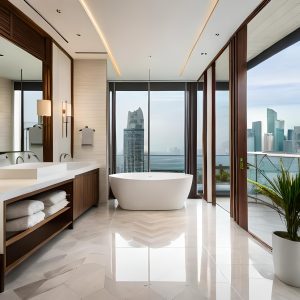
At 9Creation, we understand these pressures deeply. Our promise—Smart Renovation. Clear Pricing. Beautiful Results—reflects our commitment to creating stylish, functional interiors that respect your lifestyle and your budget. Multifunctional design isn’t about compromise; it’s about creating homes that truly support the way you live in Singapore.
HDB Resale Renovation – Maximizing Space & Functionality
Many homeowners struggle with outdated layouts and inefficient use of space in resale flats. Poor storage solutions and aging interiors make homes feel cluttered and unappealing.

✅ 3x better space utilization with custom-built storage solutions
✅ Energy-efficient lighting reduced electricity costs by 20%
✅ Modernized design increased home value by 15%
9 Creation’s expert designers optimize every corner, blending functionality with aesthetics to create a comfortable and stylish living space.

What Are Multifunctional Layouts?
Multifunctional layouts are interior designs where one space is crafted to serve multiple purposes without sacrificing comfort or beauty. In Singapore, where HDB flats and condos average smaller footprints compared to landed homes, this approach maximises every square metre.
Instead of isolating each activity into separate rooms, multifunctional layouts use zoning, intelligent furniture, and adaptive partitions to allow fluid transitions. A single space can transform seamlessly between working, dining, relaxing, and entertaining. For many homeowners in Queenstown, Bedok, and Toa Payoh, these strategies are not optional—they’re essential.

2025 Trends Driving Multifunctional Layouts in Singapore
Home-Office Integrations
The rise of remote work in Singapore has cemented home offices as a must-have. Yet dedicating an entire room is often impractical in a 3-room or 4-room HDB. In 2025, the trend is compact workstations hidden within living or dining areas—foldable desks, sliding panels, or reeded glass enclosures that appear and disappear as needed.
In a recent Bishan renovation, a retractable study unit was built into a dining wall. During the day, it provided a proper workstation with task lighting set to 400 lux at 3500K, perfect for Zoom calls. By evening, the desk folded away, returning the space to a family dining area. This balance preserved both openness and productivity without sacrificing design.

Flexible Dining and Living Zones
Singapore homes are increasingly adopting dining tables that expand for guests, modular sofas that rotate to face balconies or TVs, and ottomans that double as storage. These adaptations allow one room to morph according to family needs.
Take a 4-room HDB in Bedok: an extendable dining island served weekday breakfasts compactly, then expanded on weekends to host eight guests. Paired with modular seating, the family effectively gained a second living space without extending their footprint.

Sliding and Movable Walls
Movable walls are gaining popularity in condos across River Valley and Holland Village. Unlike solid partitions, sliding or folding panels allow homeowners to expand or separate zones dynamically. Laminated glass ensures both safety and acoustic control, while reeded or frosted finishes offer privacy without blocking daylight.
In one project, a Toa Payoh resale flat transformed its living room into a guest room within minutes using track-mounted partitions. This adaptability meant the family could welcome relatives overnight without sacrificing everyday openness.

Transformable Furniture
Furniture innovation defines 2025’s multifunctional design. Fold-away Murphy beds, extendable dining tables, desks that double as shelves, and modular sofas are increasingly common in Singapore’s compact condos.
In a Bukit Panjang condo, a wall bed concealed behind cabinetry turned a study into a guest bedroom overnight. Clearances were planned to maintain 900 mm circulation paths when extended—a small detail that ensured both safety and comfort in the compact layout.
Benefits for Singapore Homes
The biggest advantage of multifunctional layouts is adaptability. For a family in Tampines, the living room transitions seamlessly: workspace in the morning, play zone in the afternoon, and entertainment lounge by night. Each shift is effortless, supported by transformable furniture and smart lighting scenes controlled by app or voice.
This flexibility maximises ROI. Instead of building separate rooms that sit idle, multifunctional spaces provide more life per square metre. When one room serves three functions meaningfully, your cost per function drops—an invisible saving many homeowners overlook.

Compliance and Practical Considerations
In Singapore, functionality must also align with regulations. For HDB flats, always follow HDB Renovation Rules before hacking walls or adding circuits. Condos require approval from your MCST, especially for glass partitions or exterior changes. Electrical works should only be handled by EMA-licensed electricians.
Early compliance checks prevent reinstatement costs and project delays. At 9Creation, we guide clients step by step to ensure designs are not just beautiful but fully approved.

Jeremy had responded quickly to me on the first quote even though I am only doing some renovation to my kitchen and two bathroom. Jeremy is able to provide me with very good advise for the renovation.
We were very grateful to Brandon and his team to complete our renovation within a tight timeline despite many challenges encountered during the renovation. Brandon was a responsible and reliable designer who tried his best to meet our requests. He would immediately rectify issues whenever we visited the site.
Accessibility and Ageing-in-Place
Multifunctional layouts also support long-term living. By keeping main walkways at least 900 mm wide, using lever handles, and specifying slip-resistant flooring, homes remain safe and accessible as family needs evolve.
In a Queenstown project designed for ageing parents, we added motion-sensor night lighting along the bedroom corridor. This small touch created both convenience and peace of mind, proving that universal design enhances both comfort and dignity.


Real-Life Case Studies
In Toa Payoh, a 3-room resale flat transformed with modular cabinetry and movable glass partitions. The family reported an 18% increase in storage capacity while maintaining open sightlines. In River Valley, a condo owner gained a home office without losing the luxury of a spacious lounge, thanks to a reeded-glass sliding wall. And in Bedok, a multi-generational household used transformable dining furniture to adapt daily routines seamlessly.
These examples prove multifunctional layouts are not just theoretical—they’re working in real homes across Singapore today.





Frequently Asked Questions
Are multifunctional layouts expensive to implement?
Not always. While high-end transformable furniture may add upfront costs, modular cabinetry and smart zoning offer affordable entry points. With transparent renovation cost guides, 9Creation helps homeowners achieve flexibility within realistic budgets.
What are the top multifunctional layout trends in Singapore for 2025?
The leading trends are integrated home offices, flexible dining/living zones, sliding partitions, and transformable furniture. These reflect the needs of Singapore’s evolving urban families and professionals.
Do multifunctional layouts work in small HDB flats?
Absolutely. In fact, they’re essential. A 3-room HDB in Toa Payoh or Queenstown can use modular furniture and sliding partitions to serve three functions in one footprint, without feeling cramped.
What compliance rules should I know before renovating?
For HDBs, check hacking and wet work restrictions. For condos, always confirm MCST by-laws. Electrical works require EMA-licensed electricians. At 9Creation, we ensure all designs align with approvals.
How do multifunctional layouts support ageing-in-place?
By planning wide circulation, using slip-resistant flooring, and adding motion lighting, homes remain safe and functional for seniors. These touches support lifelong comfort without compromising design.
Conclusion: Envision Your Future-Ready Home
Multifunctional layouts are not about compromise—they are about creating homes that work harder and smarter for you. In Singapore, where space is precious, these designs redefine how we live in 2025 and beyond.
At 9Creation, we believe beautiful homes should be within reach—without stress or hidden costs. Whether you live in an HDB flat in Tampines or a condo in River Valley, multifunctional layouts can unlock your home’s true potential.
Book your consultation today and let’s design a space that transforms with your life.